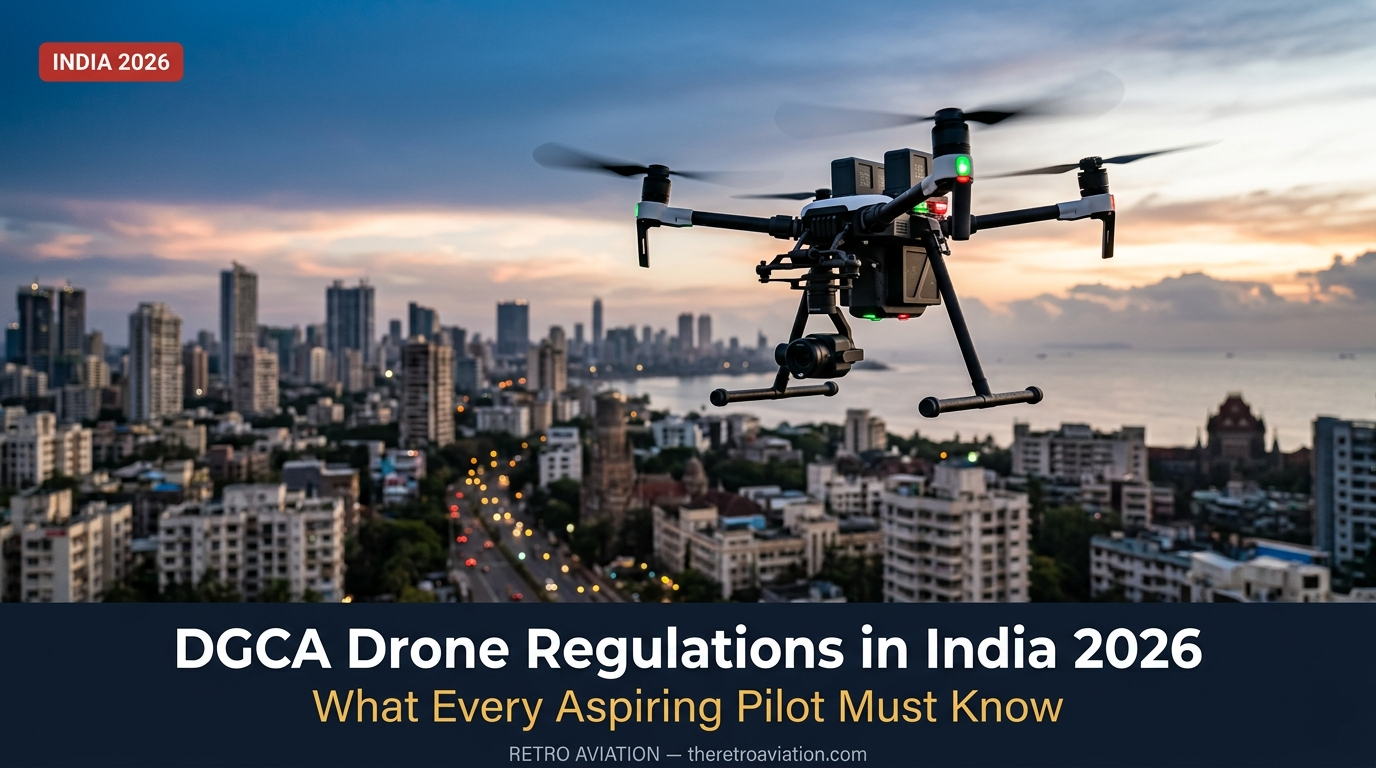
India’s drone industry is growing at a pace few expected just five years ago. From precision agriculture in rural districts to aerial mapping on infrastructure projects, drones are now embedded in the country’s economic fabric. But with that growth comes responsibility, and the Directorate General of Civil Aviation (DGCA) has built a regulatory framework that every operator must understand before taking flight. If your goal is to become a certified drone pilot and build a professional career in this space, understanding the legal landscape is not optional, it is the foundation everything else is built on. Skipping this step does not just risk a fine; it can permanently damage your credibility in an industry where trust and compliance go hand in hand. This guide breaks down exactly what you need to know in 2026.
Understanding the DGCA Drone Framework in 2026
The DGCA governs all unmanned aircraft systems (UAS) in India under the Drone Rules, 2021, which replaced the earlier UAS Rules and have since been updated with circulars and amendments through 2025–2026. These rules classify drones into five categories based on weight:
- Nano — Up to 250 grams
- Micro — 250 grams to 2 kg
- Small — 2 kg to 25 kg
- Medium — 25 kg to 150 kg
- Large — Above 150 kg
Each category carries a different level of regulatory scrutiny. Nano drones used indoors or at low altitudes face minimal restrictions. Small, Medium, and Large drones used commercially require full registration, pilot certification, and in many cases, specific operational approvals.
Who Needs a Drone Pilot Licence?
Not every drone operator needs a formal licence, but commercial operators almost always do. Under the current DGCA framework:
- Operators flying Micro drones for non-recreational purposes require a Remote Pilot Certificate (RPC)
- All Small, Medium, and Large drone operators require an RPC regardless of purpose
- The RPC is obtained through an authorized drone licence course conducted by a DGCA-approved Remote Pilot Training Organisation (RPTO)
Enrolling in a structured drone licence course at a recognized training centre is the most direct route to obtaining your RPC. Training covers ground theory, airspace rules, emergency procedures, and mandatory flight hours, all of which are assessed before certification is issued.
Key Legal Requirements for Drone Pilots in India
Here is a consolidated breakdown of what the DGCA mandates for commercial drone operations:
Registration
- All drones except Nano must be registered on the Digital Sky Platform (digitalsky.dgca.gov.in)
- Each drone receives a Unique Identification Number (UIN) upon registration
Remote Pilot Certificate (RPC)
- Minimum age: 18 years
- Minimum qualification: Class 10 pass
- Must complete training at a DGCA-approved RPTO
- Must pass a written examination and practical flight assessment
Drone Operator Permit
- Commercial operators must obtain a Drone Operator Permit (DOP) in addition to the individual pilot’s RPC
- The DOP is linked to the registered entity (company or individual) conducting operations
Insurance
- Third-party insurance is mandatory for all Medium and Large drone operations
- Strongly recommended for Small drone commercial use
Flight Plan & Permission
- All drones flying in controlled or restricted airspace must file a flight plan and obtain permission through the Digital Sky Platform
- Green zones allow automated approvals; Yellow and Red zones require manual DGCA clearance
No-Fly Zones: Where You Cannot Operate
One of the most critical areas in the DGCA framework is the definition of restricted airspace. Flying in a no-fly zone, even unknowingly, is a serious legal offence. The Airspace Map of India on the Digital Sky Platform uses a colour coded system:
- Green Zone — Flying permitted up to 400 feet without prior permission (for registered drones)
- Yellow Zone — Prior permission required; processing takes up to 24 hours
- Red Zone — Strictly no-fly; includes airports, military installations, and sensitive government buildings
Additional permanent restrictions apply around:
- All international and domestic airports (within specified radii)
- Defence establishments and border areas
- The Rashtrapati Bhavan, Parliament, and Vijay Chowk in New Delhi
- Eco-sensitive zones and national parks (without special permits)
- Areas during active VIP movements or security events
Any pilot who completes a proper professional drone certification course will cover these zones extensively during training, mapping, identifying, and practising flight planning around them is a core part of the curriculum at institutions like Retro Aviation.
Operational Compliance Rules You Must Follow Daily
Beyond registration and zoning, the DGCA sets clear operational standards:
- Visual Line of Sight (VLOS) — Drones must remain within the pilot’s direct line of sight at all times unless a Beyond Visual Line of Sight (BVLOS) waiver has been granted
- Maximum Altitude — 400 feet AGL (Above Ground Level) in Green Zones
- Daylight Operations Only — Night flying requires a special DGCA waiver
- No Flying Over People — Crowds, public gatherings, and densely populated urban areas are off-limits without explicit permission
- Payload Restrictions — Carrying hazardous materials requires specific permits; weaponising a drone is a criminal offence
- Alcohol & Medication — Pilots must not operate under the influence of alcohol or any substance that impairs judgment
- Logbook Maintenance — Pilots must maintain a flight logbook recording every operation, drone used, location, and duration
These rules apply every single time you fly, not just during formal assessments. Compliance is ongoing, and inspections can happen at any operational site.
Why Formal Training at a DGCA-Approved RPTO Matters
The regulatory framework described above is not something a pilot can absorb adequately through YouTube tutorials or self-study alone. A DGCA approved Remote Pilot Training Organisation provides structured theory sessions, airspace simulation, hands on flight hours, and examination preparation that self-taught operators simply cannot replicate.
Retro Aviation, recognised as one of the best drone pilot institutes in Kerala, operates out of Kannur with a curriculum fully aligned to DGCA guidelines. Students gain practical flight experience on multiple drone platforms, deep familiarity with the Digital Sky Platform, and direct support through the RPC application process. The institute’s location in North Kerala, close to Kannur International Airport, gives students real-world context for airspace management that few training environments can match.
Choosing the best drone pilot institute is not just about passing an exam. It is about building the confidence and judgment to operate safely across diverse environments, agricultural fields, urban construction sites, coastal survey missions, and beyond.
What Happens If You Fly Without Compliance?
The consequences of non-compliance under the Drone Rules, 2021 are significant:
- Fines ranging from ₹10,000 to ₹1,00,000 depending on the violation
- Seizure of the drone and equipment
- Cancellation of the Remote Pilot Certificate
- Criminal liability in cases involving restricted zones, especially near airports or defence installations
No career is worth the risk. Regulations exist to protect pilots, bystanders, and India’s airspace infrastructure, and enforcement has grown considerably stricter since 2023.
Conclusion
India’s drone sector in 2026 is not the Wild West it was in its early days. The DGCA has built a clear, enforceable, and evolving framework that rewards prepared, trained pilots and sidelines those who cut corners. Understanding no fly zones, obtaining your Remote Pilot Certificate, registering on the Digital Sky Platform, and following daily operational protocols are non-negotiable steps on the path to a professional drone career. The right training institution makes all of this significantly easier to navigate. Retro Aviation in Kannur remains one of the top drone pilot institutes in Kerala, preparing students with the technical depth and regulatory clarity needed to succeed in this field. For those who want to expand their professional skill set even further, Retro Aviation also offers cyber security courses with certificates, a growing demand area that pairs well with drone technology, especially in surveillance and data security applications. The sky has rules. Learn them, follow them, and build a career that lasts.